Warré plans
Warré methods
Warré modifications
Warré precursors
Groups / Fora
Google
e-group
Biobees.com
forum
Abbé Warré's book
Beekeeping for All:
Frames (and semi-frames)
The People's Hive of Abbé Emile Warré is presented as a tiered or storified, vertical top-bar hive. However there are some beekeepers who use it as a frame hive, whilst retaining several features of Warré's method. This page examines the frames issue and offers construction data on the frame versions.
Abbé Emile Warré's comments as follows regarding frames:1
- Frame honey is more costly to produce than fixed comb honey. (p. 25)
- The lower economic benefit of frame honey caused many sideliners to give up beekeeping. (p. 25)
- It is claimed that frames are essential for monitoring disease, but Warré argues that their introduction is one of the main causes of disease, as inspections cool the hive and stress the bees. (p. 27)
- The rise in foulbrood coincided with the introduction of frame hives. (p. 71)
- Berlepsch said that the foulbrood epidemic in Germany dates from the frame hive. (p. 107)
- Frames are not necessary for extraction, as fixed combs can be extracted in a suitable cage. (p. 27)
- 'Mobile' frames soon become immobile, requiring maintenance to remove propolis; fixed combs do not need this extra work (p. 28)
- Frames have to be accurately made to maintain bee space, thus increasing cost, whereas top-bars can be made relatively roughly. (p. 28)
- Frames considerably increase hive volume which makes extra space that the bees have to heat up and keep warm. (p. 28)
- Consumption of winter stores is higher in frame hives. (p. 50)
- Brood frames generally contain old cocoons which reduce cell size whereas the fixed comb hive has a faster comb replacement rate.
- Frame beekeeper produce less wax that fixed comb beekeepers. (p. 135)
- Manipulating frames risks crushing the queen. (p. 142)
- Managing frame hives is more difficult. (p. 145)
- Comb is more moveable in 'fixed comb' hives because only wax has to be cut through, not propolis as in the frame hive. (p. 146)
Pfarrer Johann Thür was a contemorary of Warré, although the two were probably unknown to each other. Thür,2 in his book promoting the vertical, top-bar hive of Pfarrer Johann Ludwig Christ (1739-1813),3 made the following comments regarding top-bars versus frames:
- Natural comb hives use a far lower weight of honey in winter than frame hives because the latter dissipate more heat. (p. 1)
- Frames suppress natural comb construction and at the same time the retention of nest scent and heat (Nestduftwärmebindung). (p. 1)
- Natural combs form spaces between them which are closed at the top and edges so heat cannot easily escape. (p. 1)
- Frames reduce yields. (p. 2)
- Epidemics have spread amongst bees because of the use of frame hives. (p. 2)
- Frames involve more know-how, more equipment, more interventions and more work. (p. 5)
Thür repeatedly stressed the importance to bee health of retaining the nest scent and heat.
Although Warré favoured hives with natural comb built below top-bars only, in early editions of his book L' Apiculture Pour Tous (Beekeeping For All), out of respect for the freedom of his readers, he offered a frame version of his hive.4 One might then ask: why not just use one of the popular frame hives in common use, such as the Langstroth? The main reasons are that: 1) the small footprint of the Warré hive of 300 x 300 mm not only makes it about the size of a natural cluster but also puts all the winter stores above that cluster where it should be, rather than partly at the difficult-to-reach periphery of a larger footprint box; and that 2) the hive boxes are sufficiently manageable to operate the frame version in the same way as the top-bar version, i.e. by adding new boxes underneath (nadiring) in spring and harvesting the honey from the box(es) at the top in the autumn.
Gilles Denis and Marc Gatineau have developed frame versions of the Warré hive for certain purposes. Attractive features of these versions are the slimness of the frames used and the retention of the internal size of the Warré box, thus allowing interchange with boxes using top-bars only. The measurements A, B, C and D in the table below correspond to the dimensions on the following diagram:
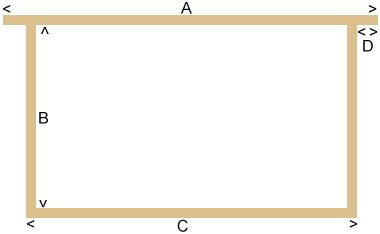
Table of comparison of frames (measurements in mm)
| Source | Top-bar Length (A) x width x thickness |
Side-bars Length (B) x width x thickness |
Bottom-bar Length (C) x width x thickness |
Top-bar lug D |
Box internal size | Number of frames | Rebate for frame lugs Depth x width |
| Warré4 | 350 x 24 x 10 | 180 x 24 x 10 | 320* x 10 x 10 | 15 | 335 x 335 x 207.5 | 9 | 15 x 10 |
| Denis5 | 324 x 24 x 7 | 190 x 24 x 7 | 289** x 24 x 7 | 17.5 | 300 x 300 x 210 | 8 | 12 x 12 |
| Gatineau6 | 326 x 24 x 8 | 188 x 24 x 7 | 286 x 24 x 7 | 20 | 300 x 300 x 210 | 8 | 15 x 14 |
* Warré bottom bars have a 5 mm bevelled projection
beyond the side bars. Thus the total length of the wood is 330 mm.
** Denis bottom bars are actually 275 mm long, i.e. fit between the side-bars, the extra
14 mm being made up by the side-bars.
All three hives appear to be top bee-space although the Denis has a 5 mm space at the top of each box (12 mm rebate minus 7 mm top-bar) and an 8 mm space at the bottom of each box (198 mm deep box below rebate minus 190 mm side-bar).
French Warré hives commercially available with frames
Bill Harley reports7: I took out 2 commercial warré bodies each from a different source. The dimensions were basically the same. The internal dimensions are 307x307mm and 305x305mm. The rebate, side to side is 327mm in both cases and the thickness of the planed wood is 22mm and the overall depth is 217 external x 200 internal. The frames are made of 25 x 7mm wood the top bar being 325mm long, the sides 202 outside and 190mm inside, inside width 270mm.
Larry Garrett's double deep brood frames and shallow (super) frames for the Warré hive: here.
Semi-frames
For increased manipulability and inspectability of combs without entirely compromising the top-bar format, some Warré users have adopted semi-frames. Gilles Denis' semi-frame is illustrated on this page. He uses these primarily in his breeding colonies. His semi-frame is intended to prevent any comb attachment to the walls at the top. However, another type of semi-frame using dowels has been adopted by Gareth John (UK). It allows comb to be built past the dowel side-bar. See illustration below.
Left: Gareth John's showing ridged comb guide. Right: Tim Moosey's, showing wax starter strips
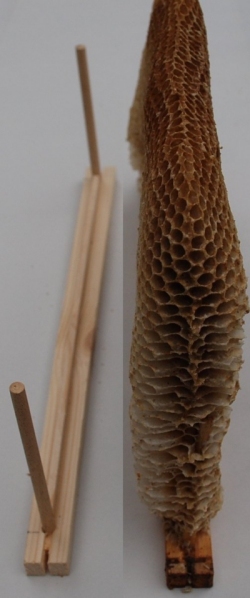
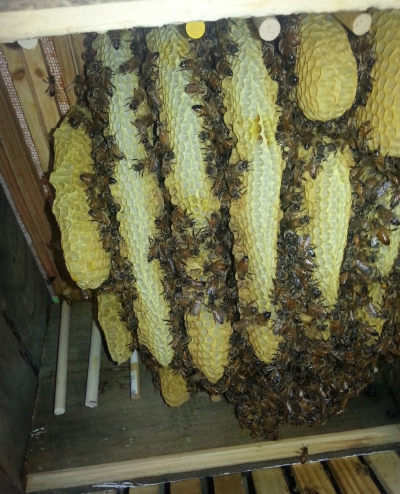
The 6 mm dowel is positioned a little way in from the side of the box. To avoid it being propolised to the box wall, the gap should be a bee space or more, e.g >7.5 mm. As the above illustration with comb shows, the bees build comb past the dowel to the wall. It can be freed in the usual way with the Warré comb knife. To ensure that the dowel is perpendicular to the top-bar, the hole should be drilled with the help of a vertical drill stand. The dowel may be glued into the top-bar, or secured merely by a tight fit in the hole. Tis particular top-bar has a wooden comb guide set in a groove.
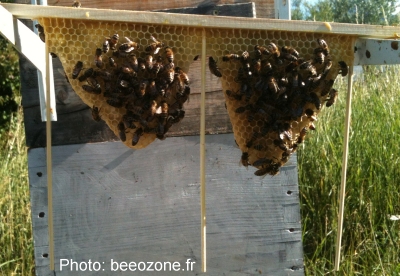
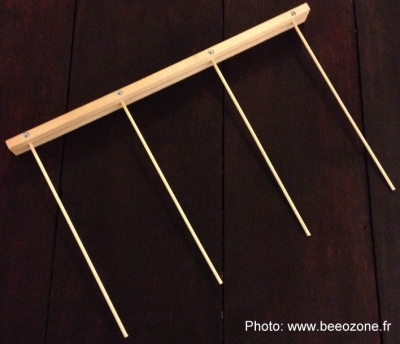
A system of semi-frames using four thin bamboo dowels or skewers, which also act as ladders when Warré hives are supered, has been developed by BeeOzone (France). The dowels are secured by screws.
Left: BeeOsense Warré comb support Right: BeeOsense Dadant comb support (showing screws)
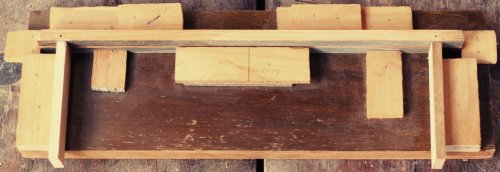
Below: example of a simple jig for assembling semi-frames (Photo: Nick Holmes).
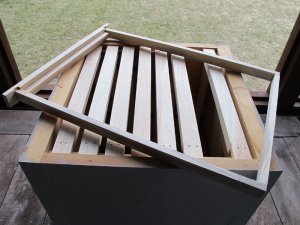
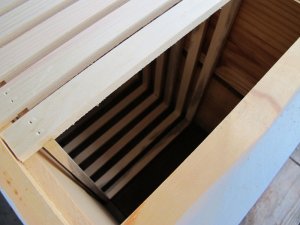
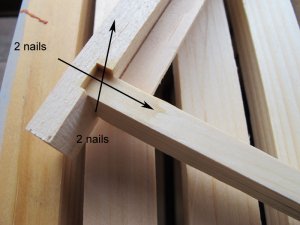
Larry Garrett's method for modifying Langstroth frames to fit the Warré hive
A piece is cut out of a Langstroth top-bar, the cut ends butt-jointed with glue and the bar reinforced with a comb guide in a groove.
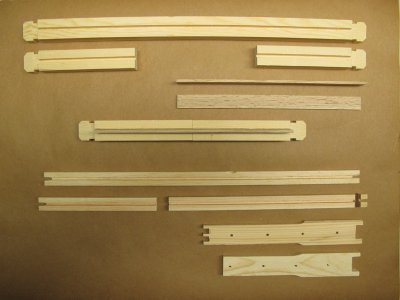
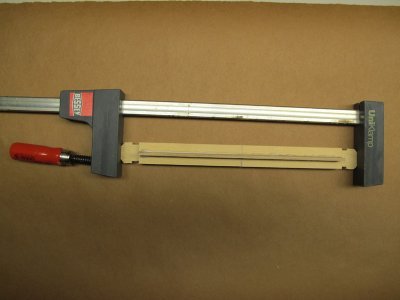
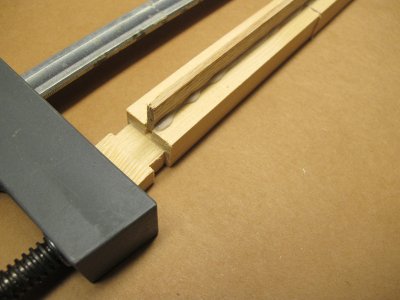
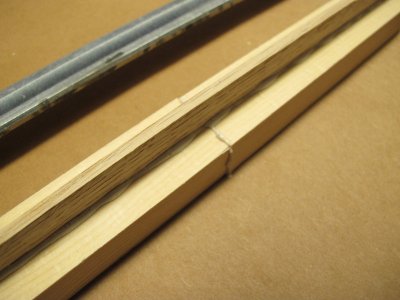
Surplus glue removed
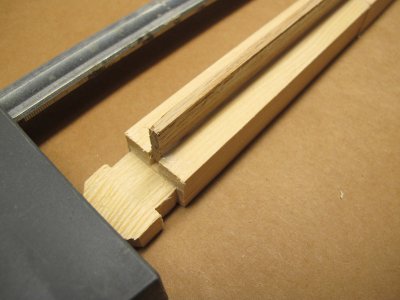
Larry Garrett's double depth Warré frames
References
1) Warré, Emile. Beekeeping For All. Translated by David Heaf and Pat Cheney from the 12th edition of L' Apiculture Pour Tous , 1948. (The 12th edition was published after he had moved to Saint-Symphorien on the outskirts of Tours, France.)
2) Thür, Johann. Beekeeping: natural, simple and successful. Translated by David Heaf from Bienenzucht. Naturgerecht einfach und erfolgsicher by Johann Thür, Imker (Wien, Gerasdorf, Kapellerfeld, 2nd ed., 1946). Download PDF: http://www.users.callnetuk.com/~heaf/thur.pdf . The German original is at http://www.seanet.com/~alexs/bien/bienenzucht_full.pdf .
3) Christ, Johann Ludwig, Anweisung zur nützlichen and angenehmen Bienenzucht für alle Gegenden, 1779
4) Warré, Emile. L' Apiculture Pour Tous. 5th edition,
March 1923. This was published when Warré was curé of Martainneville in the Somme,
France. For JPEG images of all the pages see http://ruche.populaire.free.fr/apiculture_pour_tous_5eme_edition/.
A translation of the section on the construction of the frame version is downloadable
at: http://warre.biobees.com/warre_5ed_60-71.pdf
A PDF of a scan/OCR of the 5th edition in French is downloadable at:
http://warre.biobees.com/warre_5th_edition.pdf
5) Denis, Gilles Mode d'emploi de la ruche Warré (How to use the Warré hive), 2 Rue Jean Monnet, 42650 St Jean Bonnefonds, France (tel. 33 (0)4 53 86 23). http://www.ruche-warre.com.
6) Gatineau, Marc L'apiculture, telle que je l'aime et la pratique (The beekeeping I love and practise) http://www.apiculturegatineau.fr/
7) Email to the former warrebeekeeping Yahoo e-Group on 17 June 2012, message number 28,460.