Warré plans
Warré methods
Warré modifications
Warré precursors
Groups / Fora
Google
e-group
Biobees.com
forum
Abbé Warré's book
Beekeeping for All:
Hefting the Warré hive
When assessing the amount of stores to leave for winter, Warré advises counting full combs of honey.1 One comb weighs about 2 kg, so six combs are needed to make up Warré's recommended winter stores weight of 12 kg. This would of course apply to the climatic conditions of northern France. In other places, greater or lower weights of stores may be needed.
Counting full combs of honey requires that the boxes be inspected from above and below, or that combs be individually removed. But if one wants just to assess the weight of stores without opening the hive, the hive can simply be hefted. The traditional way of hefting is to lift one side of the hive slightly and feel the weight. The hefting can be limited to one or two upper boxes. Experience will tell whether the felt weight is satisfactory or not. However, this will seem somewhat unreliable, especially to beginners who do not know what a well stocked hive should feel like. And there may be circumstances when even experienced beeks want more accurate knowledge of the weight of stores present. The solution then is to use some kind of weighing device. This page looks at the options, starting with the cheapest and simplest, though possibly the least accurate solution.
Weighing with a digital luggage scale
Inexpensive luggage scales are particularly convenient for hefting, especially those that give a signal when a stable reading is reached and fix that reading on the digital display. The following is an example (Silver crest, Lidl UK):
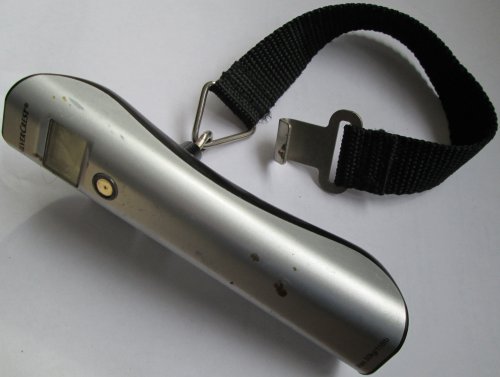
The metal hook holds securely under a box handle. Looking at the photo above: the scale's handle can be held to the right of the strap mounting giving a clear view of the display. The box or boxes being weighed must first be freed of bridge comb and propolis adhesions to the box or floor below. The weight readings are made on both sides and added.
From the combined weights, subtract previously measured weights for the following (your boxes and top-bars may differ):
Weight of box(es) (e.g. 4 kg for each box)
Weight of top-bars (e.g. 8 x 37 g = 0.296 kg for one box)
Weight of empty combs (e.g. 8 x 83 g = 0.664 kg for one box)
Weight of bees (e.g. 20,0002 x 0.93 g3 = 1.86 kg. Most
colonies by autumn may weigh less than this, but it is better to overestimate than
underestimate))
The resulting weight of stores will include the pollen reserve.
Weighing with a spring balance
A common suggestion for weighing hives to assess stores is to use a spring balance supported on a lever arrangement improvised with two pieces of wood and a pivot. To weigh two Warré boxes, a 25 kg 'Pocket Balance' would suffice. The roof and quilt are removed and the balance is hooked under the handle on each side in turn and the observed weights added.
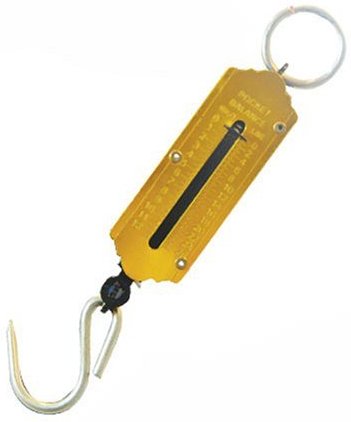 Spring balance
From the combined weights, subtract previously measured weights for the following (your boxes and top-bars may differ):
Weight of box(es) (e.g. 4 kg for each box)
Weight of top-bars (e.g. 8 x 37 g = 0.296 kg for one box)
Weight of empty combs (e.g. 8 x 83 g = 0.664 kg for one box)
Weight of bees (e.g. 20,0002 x 0.93 g3 = 1.86 kg. Most colonies by
autumn may weigh less than this, but it is better to overestimate than underestimate)
The resulting weight of stores will include the pollen reserve.
To increase control over the amount of lift, for example to lift just enough to take the weight, but not so much that bees come out of the gap created, the lever can be replaced by something with a screw thread. A joiners' sash cramp is suitable for this. The spring balance is hooked to the screw and connected with a chain and hook to the Warré box handle. See images below.
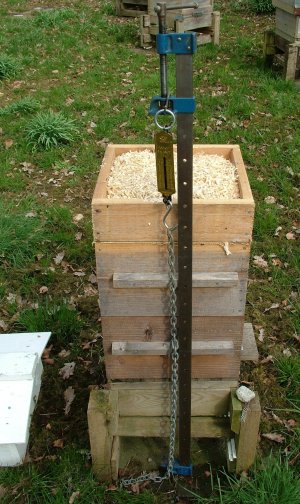
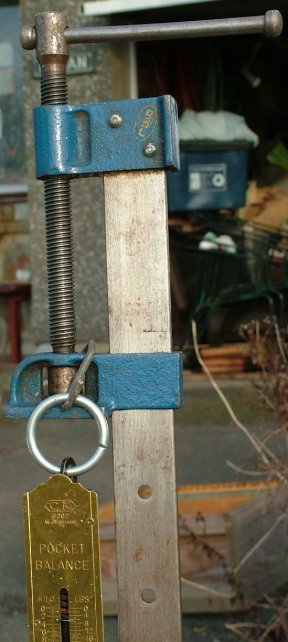
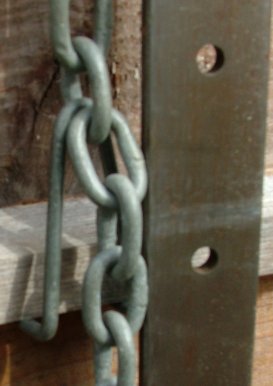
As the lifting is by the box handle, while the other side is pivoted on the rim of the box, this asymmetry introduces a slight underestimate of the stores weight of 8%.4 As it is safer to underestimate than overestimate winter stores, this error can be justifiably neglected.
The above methods could be made more accurate with a suitable, though possibly more expensive, digital weighing device, such as a baggage scale. Depending on the choice of scale, this may be easier to read and more sensitive.
More details of how to use this apparatus are given on David Heaf's website at:
http://www.dheaf.plus.com/warrebeekeeping/hefting.htm
Weighing with a weighing platform and digital scale
The above mentioned error is eliminated, the weighing conditions standardised, and the sensitivity increased by using a Andrew Janiak's beehive scale illustrated below.
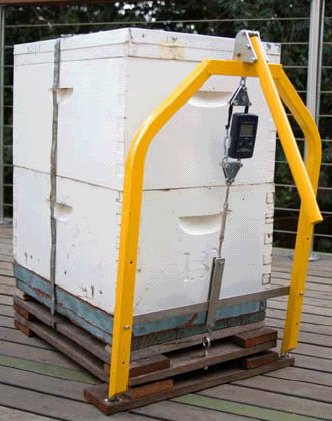
The hive rests on a hinged platform fitted with a hook. A U-frame, resting in pivot slots on the platform, supports a digital weighing scale which is connected at the top end to a lever and at the bottom end to the hook. Lowering the lever handle lifts the hive and registers the weight on the scale. As only one side of the hive is lifted, and the load on the scale is further divided in two by the supporting apparatus next to the scale, the reading is multiplied by 4 to get an approximate hive weight.
The system can be calibrated by placing a known weight on the roof. The display is accurate to 60 g, i.e. 240 g (about half a pound) for the whole hive. The sensitivity is suitable for monitoring small weight fluctuations throughout the season.
The operation of the beehive scale, including instructions on how to construct the platform, is detailed in the user manual (PDF). A video of the beehive scale is available at:
http://www.abc.net.au/tv/newinventors/txt/s2570802.htm
Andrew Janiak can be contacted by email at andrew.janiak (at) gmail.com.
Weighing with lift and digital bathroom scales
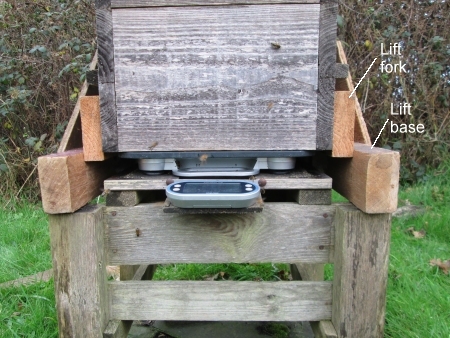
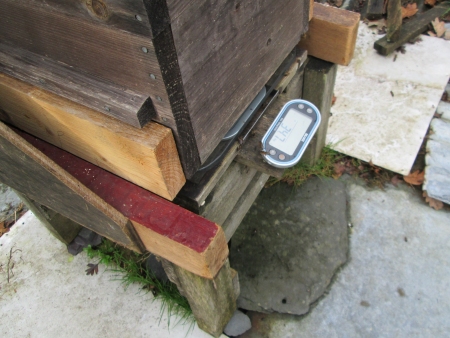
The roof and quilt are removed but the top-bar cover cloth is left in place to minimise heat loss and disturbance to the bees. A Warré hive lift is used to raise the hive boxes sufficiently to create a gap between them and the floor to insert a digital bathroom scale. The one in the photo has a tempered glass platform 320 x 320 mm square, so is wide enough to hold standard Warré boxes. The LCD screen communicates by infra red with the scale and is placed on the alighting board. When the scale is inserted, it is pressed down manually to trigger the power on switch and the self-zeroing function. The boxes are then lowered onto the scale and the reading on the LCD screen noted.
The particular scale illustrated is no longer available, but others with detachable LCD screens and wireless communication still exist for as little as $12, e.g. Camry's with an infra-red screen. Scales with a screen that projects beyond the foot platform would also work in this application. Any that are less than 310 mm wide would need a board of suitable width inserted between the scale and the boxes.
Warré lift incorporating a scale
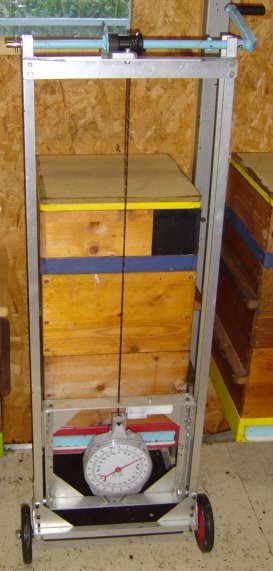
This fork lift picks up the hive by the handles. The weight of the whole hive is registered on the scales. For more photos, see:
http://laruchewarre.topic-debate.com/vos-ruches-en-photo-f5/elevateur-pour-ruche-warre-gg-t48.htm
Torque wrench hefter
A hefter which weighs the hive with a torque wrench fitted to a suitable adapter, is described in a PDF document which can be downloaded at the following page:
http://windmillhillfarm.com/honey_hefter_instructions.htm
The adapter is called a 'lever arm' in the document.
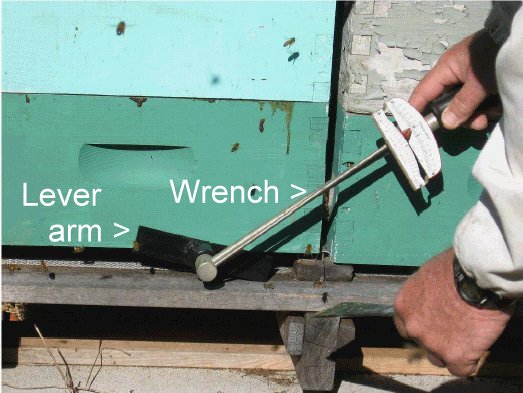 Torque wrench hive
hefter
Torque wrench hive
hefter
This compact device could be used with a Warré hive by putting the lever arm between the stand and the rear of the floor of the People's Hive.
Compact prizing action hefter
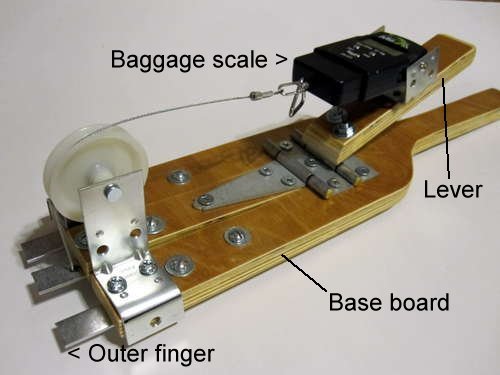
The outer fingers rest on the hive's floor board. The inner finger lifts the hive when the lever attached to the baggage scale is depressed towards the base board.
Construction details: www.instructables.com/id/Build-a-scale-to-weigh-bee-hives/
But see also primary source for snags : http://www.beehacker.com/wp/?page_id=55
Ravi Pendkar's compression spring method
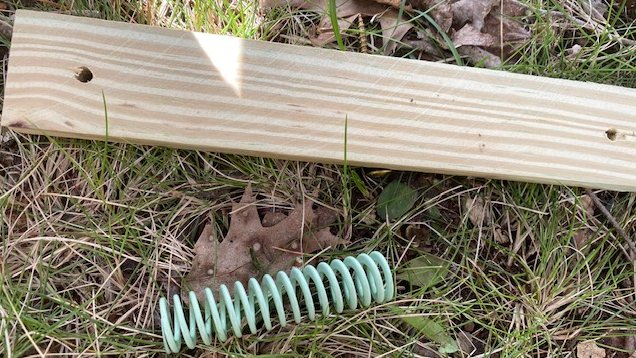 spring and adjusting bar
Below left: Support bar for spring and two compression adjustment screws
Below right: Measuring the compression of the spring with calipers
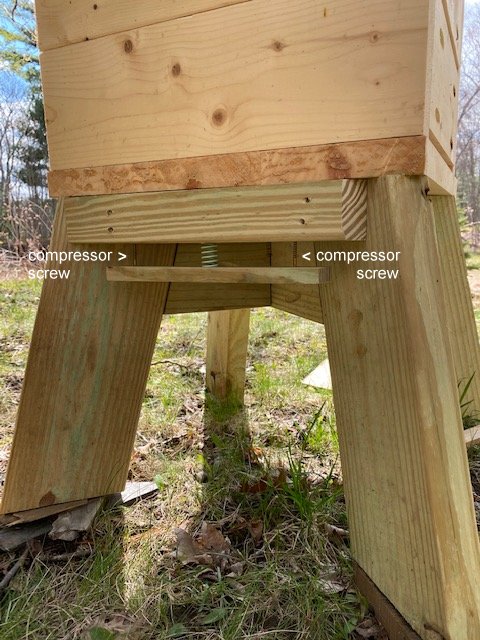
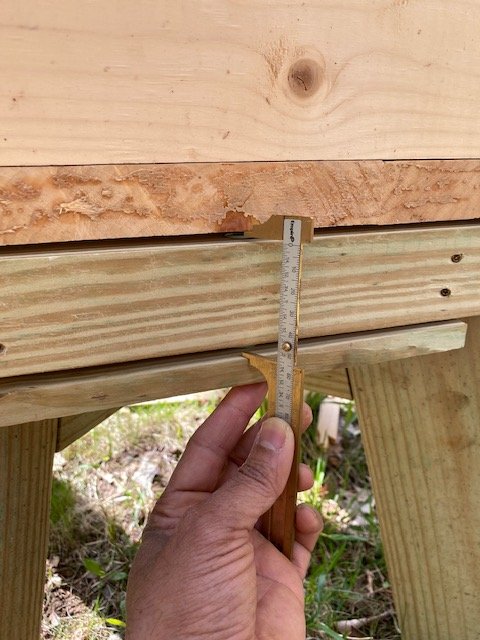
Ravi's weigher uses high quality springs that are used in the plastics molding industry. The springs have a well defined compression rate. The 'scale' is just a 3/4" hole bored into the skirt of the stand. The said spring sits (protected from overloading) in the bore hole and is pushed up by a bar of wood using two compression adjustment screws. When the rear end of the hive bottom board 'floats' on the spring, the length of the spring is measured using a woodworking caliper. The compression measurement is converted to weight of the 'bee stuff', 16 lbs. in this instance.
In order to avoid the hive tipping forward in the wind, the pressure on the spring is released when not hefting.
The key is to make sure that the bore hole is deep enough to protect the spring from over-compression damage. The 'safe compression range' and 'rate of spring compression' ( kgs/mm) are specified by the spring vendor, as these are used in molding machines through millions of cycles. The spring illustrated was from specialspringsna.com. The specific spring is VL20-076 which fits a 3/4" diameter 2" deep bore hole. The spring length is 3" (76mm) with a compression rate of 1Kg/mm. Gives a range of around 50 kgs ( 25 kgs times two) over the 1"(25mm) safe range of compression allowed. A second spring could be added, or, for bigger hives a stiffer spring.
References
1. Warré, É. (2010) Beekeeping for All. Northern Bee Books. Transl. by Heaf, D. J. & Heaf, P. A. from L' Apiculture pour Tous 12th edition. (Saint-Symphorien, 1948). Beekeeping for All is also available as a free download at http://warre.biobees.com/bfa.htm . p. 109.
2. Seeley, T. D. & Morse, R. A. (1976) The nest of the
honey bee (Apis mellifera L.) Insectes Sociaux 23(4), 495-512. Seeley &
Morse found an average of 17,800 bees in 5 thriving feral/wild nests in July/Aug. They
other investigators having found maximum populations of 27,000, 32,000, 42,000 and 45,000
in frame hives.
Morse, R. & Hooper, T. (1985) The illustrated encyclopaedia of beekeeping.
Blandford Press. p. 19. Morse & Hooper's graph of the annual cycle of the hive
population shows a value of 20,000 bees at the end of September. This has fallen to 10,000
by the beginning of January and about 4,000 by the end of February.
Winston, M. (1987) The biology of the honey bee. Harvard University Press. p.
183. Reading from Fig. 11.1, Winston cites about 14,000 as the population at the end of
September. p. 183.
3. Winston, M. (1987) The biology of the honey bee. Harvard University Press. p. 54.
4. A spreadsheet compiled by Jonathan Powell from David Heaf's calculations is available at hefting_error_correction.xls